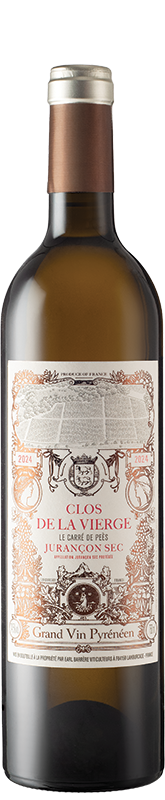
Clos de la Vierge 2024
Wine Details
- White - Dry
 France
- Jurançon AOC
- Gros Manseng
- 14.5% ABV
- 750 ml
Flavor Profile
Clos de la Vierge is the signature cuvée of Domaine Barrère, a tiny, family-owned estate in the Jurançon, a historic wine region seated in the Pyrenees foothills of southwest France. Like most of the area’s wines, it’s made with Gros Manseng, an indigenous white grape with thick skins, high acidity and high sugar levels. Unlike those bottlings, however, it’s dry on the palate and textural, with stone fruit, pineapple and fresh floral characteristics that add depth to its mouthfeel.
Sister-proprietors Christiane and the late Anne-Marie Barrère had been using fruit from their nine-ish acres of vines to make small lots of stunning, terroir-driven wines like this for at least the last five decades. (In fact, their father was instrumental in achieving national recognition of the style back in the early 1900s.) But sales of their production were kept almost entirely within their locale until 2023.
That’s when we got word of what they were doing.
After tasting through their range—and being floored by each bottle—they revealed how they were struggling more and more to sell to locals. We offered to shepherd their wine Stateside, and they jumped at the chance to get this one out into the world.
Our first shipment of the stuff sold out in mere weeks, as has every release since.
This particular vintage is extra special: It marks a new chapter for the estate, now under the direction of winemaker Damiens Sartori, who jumped in to steer the operation when Anne-Marie passed away suddenly.
“I paid close attention, following Anne-Marie’s direction for years as her assistant,” he says. “Our philosophy has always been the same, so it was not difficult to take over.”
As always, the wine is nervy, layered and utterly delicious, made entirely from one favored plot (or carré, as shown on the label) of Gros Manseng. “It has a nice soft yellow color, with a brightness around the edges. Its nose is full of exotic fruits and a bit of vanilla, its palate is incredibly refreshing,” says Damiens. “If you know how to wait, its evolution in bottle will be really nice... but we’ll have to talk about that in three years from now!”
Stocks of the wine are miniscule and will sell out. Order soon if you hope to taste some.
Clos de la Vierge is the signature cuvée of Domaine Barrère, a tiny, family-owned estate in the Jurançon, a historic wine region seated in the Pyrenees foothills of southwest France. Like most of the area’s wines, it’s made with Gros Manseng, an indigenous white grape with thick skins, high acidity and high sugar levels. Unlike those bottlings, however, it’s dry on the palate and textural, with stone fruit, pineapple and fresh floral characteristics that add depth to its mouthfeel.
Sister-proprietors Christiane and the late Anne-Marie Barrère had been using fruit from their nine-ish acres of vines to make small lots of stunning, terroir-driven wines like this for at least the last five decades. (In fact, their father was instrumental in achieving national recognition of the style back in the early 1900s.) But sales of their production were kept almost entirely within their locale until 2023.
That’s when we got word of what they were doing.
After tasting through their range—and being floored by each bottle—they revealed how they were struggling more and more to sell to locals. We offered to shepherd their wine Stateside, and they jumped at the chance to get this one out into the world.
Our first shipment of the stuff sold out in mere weeks, as has every release since.
This particular vintage is extra special: It marks a new chapter for the estate, now under the direction of winemaker Damiens Sartori, who jumped in to steer the operation when Anne-Marie passed away suddenly.
“I paid close attention, following Anne-Marie’s direction for years as her assistant,” he says. “Our philosophy has always been the same, so it was not difficult to take over.”
As always, the wine is nervy, layered and utterly delicious, made entirely from one favored plot (or carré, as shown on the label) of Gros Manseng. “It has a nice soft yellow color, with a brightness around the edges. Its nose is full of exotic fruits and a bit of vanilla, its palate is incredibly refreshing,” says Damiens. “If you know how to wait, its evolution in bottle will be really nice... but we’ll have to talk about that in three years from now!”
Stocks of the wine are miniscule and will sell out. Order soon if you hope to taste some.


winemaker Damiens Sartori